October 9, 2026
Crypto & AI Privacy Is Inevitable.
 Bart Hillerich
Onchain privacy is being repriced.
YTD, we’ve seen the narrative dominate industry discussions, with ZEC (+178%), VVV (+1,578%), and NEAR (+264%) becoming standout performers in portfolios, while XMR (+28%) and LINK (+17%) have also shown strength.
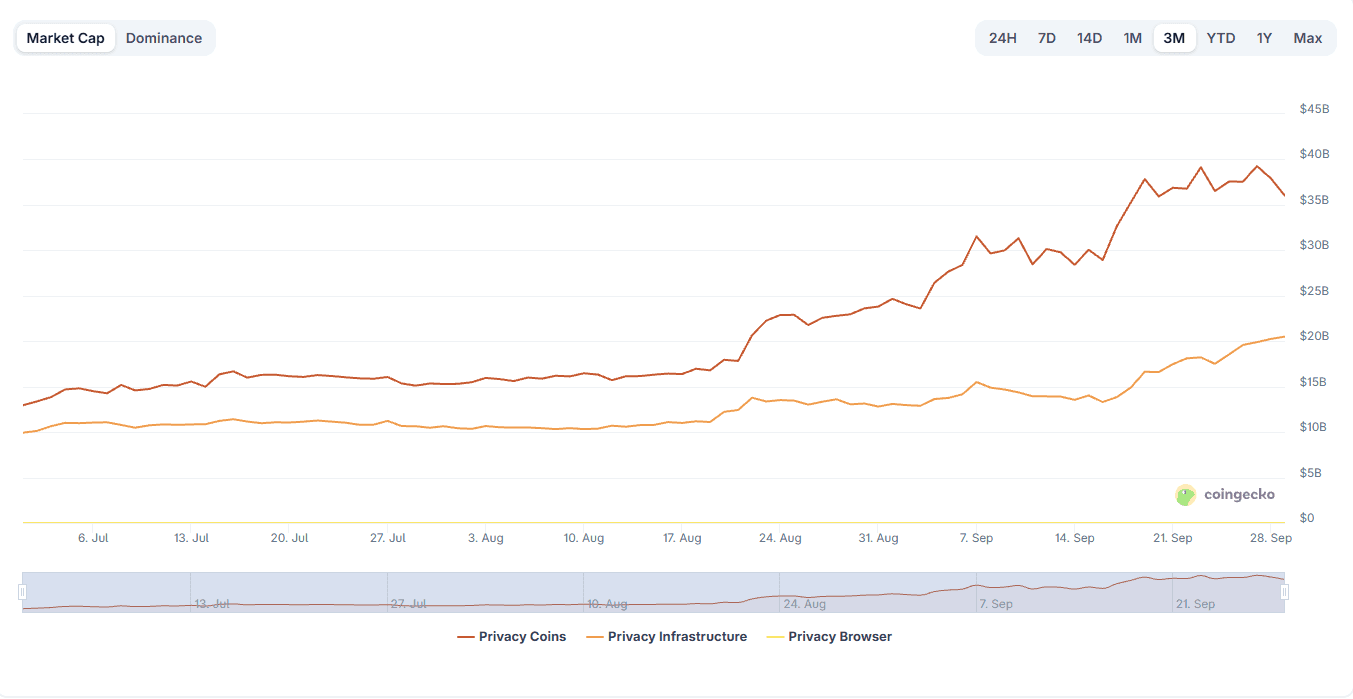
Zooming out, the privacy coins and privacy infrastructure categories have surged in Q3, growing in aggregate market cap by ~178% and ~106%, respectively.
And I don’t see this train slowing down anytime soon, especially when we consider how AI is developing.
Privacy is now a defining issue across AI.
We’ve seen President Trump emphasize the privacy of the site’s AI portal at the launch of America.gov, OpenAI come under fire for the Navier–Stokes Millennium Prize controversy, warnings from investors such as Jason Calacanis about exposing proprietary work to centralized AI platforms, and plenty of other examples.
All things considered, I think privacy will become ubiquitous across AI. And as that plays out, crypto’s chapter of transparency will come to a close.
For both, it’s actually pretty simple logic as to why.
The Case for Crypto Privacy
Let’s start with crypto.
Institutions across the board, from BlackRock and Robinhood to banks, funds, and payment providers, are all coming onchain.
Every asset will be tokenized, and markets will be universally accessible, with trading live 24/7/365.
And in case you’ve been living under a rock, none of that is a novel insight. At this point, these are universally accepted, inevitable truths.

But the caveat is that these institutions don’t want their activity public, and onchain markets are known to be an exploitation playground due to the lack of privacy.
Entire categories of applications, investment strategies, and institutional workflows remain offchain, as they would be exploited the moment they touched the network. As a result, vast amounts of capital, stays sidelined to avoid the vulnerability.
A fund doesn't want competitors watching it build a position. A company paying employees in stablecoins doesn't want everyone's salary visible. Sending someone money shouldn't let them look through the rest of your account.
Plain and simple, privacy becomes a much bigger part of crypto the more people use it for their actual finances, which is why the OG privacy teams have been working on this for over a decade.


So if you share the common belief that all of finance will operate on crypto rails, congrats, you’re also an onchain privacy bull. You simply can’t have one without the other.
And when it comes to AI, privacy is heading in the same direction, only faster, because users are increasingly handing their entire lives to these tools.
The Yin to Crypto’s Yang
AI’s privacy problem comes from the opposite direction of crypto.
Crypto starts with public rails and needs privacy so people can use those rails for real financial activity. AI starts with private context and needs privacy so people can safely give models the information that makes them useful.
A generic model can, for example, answer a generic finance question with public information, but meaningfully helping you make sense of your own finances requires much more. Income, liabilities, bank statements, tax documents, investment history, personal goals.
The same is true for businesses. Companies that know better do not want customer records, internal research, code, legal documents, or strategy decks exposed to the model provider just for better analysis.
In both cases, what we see is that the highest-value AI workflows are often the ones that require the most confidential data.
That is why privacy cannot stop at the application layer. The infrastructure itself has to change.
Private inference is the important primitive here. The goal is to let a model produce a useful answer without giving the infrastructure operator full visibility into the prompt, files, or output. Users get the intelligence they came for, while keeping control over the material used to generate it.
This is also where AI privacy starts to blend a bit with crypto privacy. In crypto, the network should verify the transaction without exposing the transaction to everyone. In AI, the infrastructure should run the computation without exposing the user’s context to everyone involved in processing it.
This got me wondering if there are any startups tackling both problems at once, so I went down the rabbit hole of exploring the privacy landscape across both industries.
Here are some of the categories and projects that I’m seeing interesting developments.
Private Money
Zcash has had a very impressive 2026 campaign.
What makes the recent move interesting (outside of all the technical achievements like Orchard and Halo 2, Unified Addresses, and Ironwood’s new shielded pool, is that the bull case now has usage behind it.
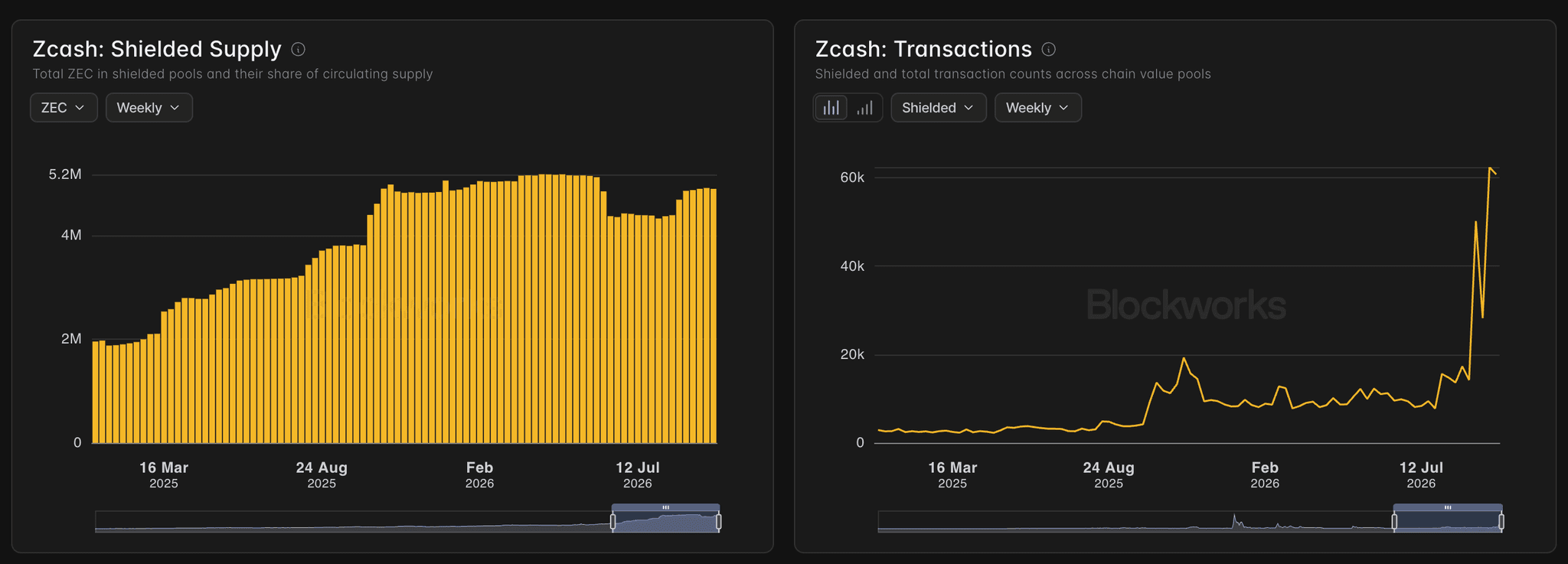
Roughly 4.9 million ZEC, or about 29% of circulating supply, now sits in shielded addresses, up from 8% in early 2024, while shielded transactions just hit ~62,000 weekly transactions, up 652% YTD.
The growth here is showing up where it matters, in private usage.
It’s a big reason why bigger names have been getting involved in Zcash.
The Winklevoss twins, for example, launched Cypherpunk with $100 million to acquire ZEC for its treasury and said the company aims to accumulate up to 5% of circulating supply, with Tyler Winklevoss calling AI “the dawn” of the privacy catalyst.
Zcash also affords its users a scale for how much privacy they want.
It supports transparent and shielded transactions, so the privacy users get depends on how they use the network. It also includes a practical disclosure layer. Viewing keys let an authorized party see transaction information without the ability to spend the funds. That helps with audits, compliance, or any situation where someone needs selective transparency instead of total exposure.
Private money is about more than hiding from someone. It makes digital cash usable for everyday financial life.
That is why Zcash continues to outperform the market.
Zama
Zama is the team that made fully homomorphic encryption practical and fast enough for widespread usage in blockchain and AI, arguably kicking off the privacy bull run.
For the non-technicals, the innovation essentially means that your data can stay encrypted even while a program is using it.
The best way to think about Zama is to start with the common Zcash analogy. While Zcash is like private Bitcoin, Zama is more like private Ethereum, providing a programmable confidentiality layer for public blockchains, enabling encrypted balances, transactions, and application logic across a wider range of assets and use cases.
I’m seeing the team take more of an institutional approach here with their GTM. Zama just launched confidential vaults and the Zama Confidential Swap protocol.

Vaults - enables users and institutions to deposit into the same curated Morpho yield strategies already used by institutional capital (from Wintermute’s Armitage, Bitwise, Flowdesk, RockawayX, and Steakhouse) while keeping balances, positions, and activity encrypted the entire time.
Swap protocol - enables enables swapping directly between confidential assets on Ethereum without revealing trade size, direction, or intent, so the full loop of shielding, depositing, earning, and rotating capital stays private.
So far, it’s working. Zama protocol shielded TVL has grown by more than $20M since launch.
Private Applications
Defaults shape behaviors.
If privacy requires extra steps, plenty of people will skip them. So I’m looking for teams building at the application layer to handle those steps for users without all the technical mess; that way, users can get the benefit without understanding the cryptography underneath.
I think the teams that do this well will become big winners, as they’ll serve as core onboarding points to private AI and crypto.
I’ve seen this playing out already this year with Venice. Most people think about the app as private AI, and that’s because it’s under-the-hood crypto components are all abstracted away. From this formula, the app recently crossed 4 million users and $100 million ARR:


Crypto wallets are another obvious opportunity because it’s where privacy has oftentimes fallen apart.
If a wallet is used for several things, someone who knows where you receive payments may also be able to follow where you trade, what you hold, and how the rest of your financial life moves.
Technically, users can try to work around this by opening more wallets. But that adds friction, and it still does not guarantee that their activity cannot be linked.
I don’t think most people will want to manage that themselves. They will expect privacy from the wallet or application, much like they expect it from a banking app.
That is where I see demand coming from. People want to use these products without giving strangers access to the rest of their finances, and achieving this should feel invisible and seamless to users, not like a research project.
Zodl is a good example here.
It was built by the original developers of the Zcash protocol, and comes with privacy by default, private swap support, and pairing with Keystone for air-gapped shielded signing.
Overall, when it comes to applications, I want to see how this translates into sustained use of shielded money long-term.
While, yes, strong token price can bring people in, prolonged application usage is a much more concrete evidence point for privacy demand.
Because I’m interested in private applications, I’m also looking at Arcium.
Arcium
Let’s quickly recap some of the privacy key players. Zcash made private money investable, Zama solved Fully Homomorphic Encryption and is enabling privacy to be applied everywhere onchain, and Venice broke out of the crypto echo chamber with a killer private AI consumer product.
Each of these owns one layer of the stack, and as such, the privacy trade itself has been fragmented.
And that’s what gets me excited about Arcium.
Instead of locking in on one privacy element, they’ve packed everything together and are shipping across the entire stack:
- Programmable private money with C-SPL and Umbra (Zcash)
- Encrypted computation (Zama)
- Confidential AI inference with Blackthorn (Venice)
| Project | What they own | Arcium’s Advantage |
|---|---|---|
| ZEC | Private money, the OG privacy asset | Extends privacy beyond a dedicated coin: C-SPL adds programmable confidentiality to any Solana asset, while Umbra received $150M in commitments in Solana’s largest-ever ICO. |
| Zama | General encrypted compute for blockchains (FHE) | Live on Mainnet, powering 10+ apps (the most active privacy ecosystem in crypto) with nearly 3M computations executed. |
| VVV (Venice)/Phala/Near | Private AI inference / Infra | Blackthorn extends Arcium from encrypted compute to confidential AI on encrypted GPUs, keeping prompts, files, and outputs private—and enabling Venice-like apps. |
This unified package is why I like Arcium from the applications standpoint; it means that privacy can actually become something applications use in the background.
Furthermore, while the other privacy projects mentioned have been working on crypto’s privacy problems, Arcium has made moves to go beyond its original mission of bringing encrypted compute to blockchains to extend the network to do the same for AI.
Here’s how it all works (first the technical side, then what it actually means for you).
Technical Approach
Arcium’s core approach is secure multi-party computation (MPC). Private inputs are split into secret shares and distributed across a Cluster of Arx nodes. The nodes jointly evaluate the computation without any one of them reconstructing the underlying data.
Arcium’s current protocol, Cerberus, uses a dishonest-majority, detect-and-abort model. As long as at least one Cluster member is honest, it preserves privacy and detects tampering; if a protocol fault occurs, it aborts rather than returning a corrupted result. That protects confidentiality and result integrity.
That makes the design a natural fit for crypto: public chains can handle coordination and settlement while private application logic runs across the cluster.
Compared with a TEE, trust is distributed instead of being concentrated in one enclave; compared with FHE, MPC requires more interaction, but maps well to decentralized workflows that already coordinate across multiple parties.
The tradeoff is added communication and a possible abort when nodes or the network are unavailable.
But the same architecture does not have to stop at blockchain applications. If computation can be distributed so no single operator sees the underlying inputs, the same model can extend to AI workloads involving sensitive prompts, files, and other user data.
The AI Expansion Bet
That extension beyond crypto is becoming a bigger part of Arcium’s bet.
We’ve seen how Venice built a successful AI product on crypto rails; Arcium is looking to push those rails further into the backend.
Instead of owning the user-facing chat experience, it is building confidential infrastructure beneath it, designed so sensitive prompts, files, and outputs do not have to be exposed in plaintext to a single infrastructure provider.
It’s a different side of the same bet.
That is what makes Blackthorn interesting. It is designed to run confidential AI on the NVIDIA GPUs that data centers already use, instead of requiring a new security chip or dedicated confidential hardware. If it works as intended, that could open sensitive AI workflows in healthcare, finance, law, and government without requiring users to hand the underlying data to a conventional hosted-model provider.
It’s Arcium not choosing between crypto privacy and AI privacy. The team is working to make both usable through one distributed system.
What it Means for Users
The point of Arcium’s confidential computation isn’t to hide everything. Instead, it’s to reveal only what the application needs.
For users, that might mean an auction calculating a clearing price from confidential bids without publishing every losing bid, or a trading application keeping sensitive order information private while executing its rules, so the useful output is available without turning the underlying inputs into public market intelligence.
The kinds of products Arcium is pointing toward are already visible in its ecosystem directory, which includes Crafts, a sealed-bid token auction project, and Umbra, a wallet for shielded transfers and swaps.
Developers can add confidential functions and state alongside the public parts of a Solana application, choosing which information the application exposes.
Arcium also has C-SPL, its confidential token standard for Solana, bringing confidential balances and transfer amounts to token applications without requiring users to move into a dedicated privacy asset. That could support stablecoin payroll where employees do not see one another's salaries, or auctions where participants can verify the result without publishing every losing bid. These are reasons to use a product even if you have never traded a privacy token.
The same logic applies to AI. The goal is not to make useful computation impossible by locking data away, but to let applications use sensitive information without unnecessarily revealing that information to the infrastructure performing the computation.
To me, that’s the larger opportunity.
What I’m Watching
Moving forward, privacy will continue to be a top category on my watchlist.
For Zcash, I'm watching to see how routine shielded activity can become. Better wallets and easier access should show up in people using the network for its defining feature.
As a trader, I want to understand how usage reaches the assets that back some of these crypto-native projects.
Will teams tune their flywheels right, so that onboarding effectively generates buying pressure?
There’s also a lot at stake with privacy network effects because of a lack of composability.
When assets are shielded with one technology, they’re not actually composable with assets shielded with another technology. So there’s an urgent need among teams to build liquidity/onboard institutional capital, get the best depth for swaps, offer better yields, etc.
How that plays out will determine how the onchain privacy pie is divided.
On the AI side, I’m paying close attention to what’s happening around the frontier labs.
With all the fearmongering that’s been going on lately, will regulators step in meaningfully, and will user privacy be a part of their policies?
I’m also looking out for teams making the push at the crypto x AI x privacy intersection. We already have some proof points that it works and compelling stories. I want to see how large these user bases grow, and what % of total AI usage private AI can capture.
Here, it’s really a matter of how much people actually care about their personal privacy, and Venice and Arcium are the projects I’m following because they approach the same thesis from a different angle: Venice at the frontend UI, Arcium in the deep infrastructure.
With how interlinked crypto and AI continue to become, it’s teams competing in that melting pot that have a strong chance of capitalizing on the two trends I think we can all agree will continue: finance will continue to move onchain and, in turn, grow privacy adoption, and demand for user privacy will continue to grow as AI adoption increases.