September 29, 2026
How Stablecoin Issuers are Becoming Machine Economy Powerhouses.
 Bart Hillerich
I’ve come to the conclusion that what we commonly think about stablecoins is just the tip of a very deep iceberg.
Let’s start at the beginning.
As you probably already know, stablecoins began with the proposition to make dollars move at internet speed.
Early on, pioneers like USDT and USDC gave crypto traders a dollar-denominated asset they could move between exchanges and blockchains without repeatedly entering and exiting the banking system.
Then in 2020-2021, things got pretty crazy.
Up until that point, stablecoins had grinded for years below $5B in total market cap. In 2021, they exploded to a peak of $187B before entering a decline alongside the broader crypto market downturn.
Fast forward to today, and stablecoins are now a $300B asset class with around $202 billion in average daily transfer volume. Tether's USDT remains the dominant asset, having just ended the second quarter of 2026 with approximately $184.6 billion in circulation, while Circle reported $73.3 billion of USDC in circulation.
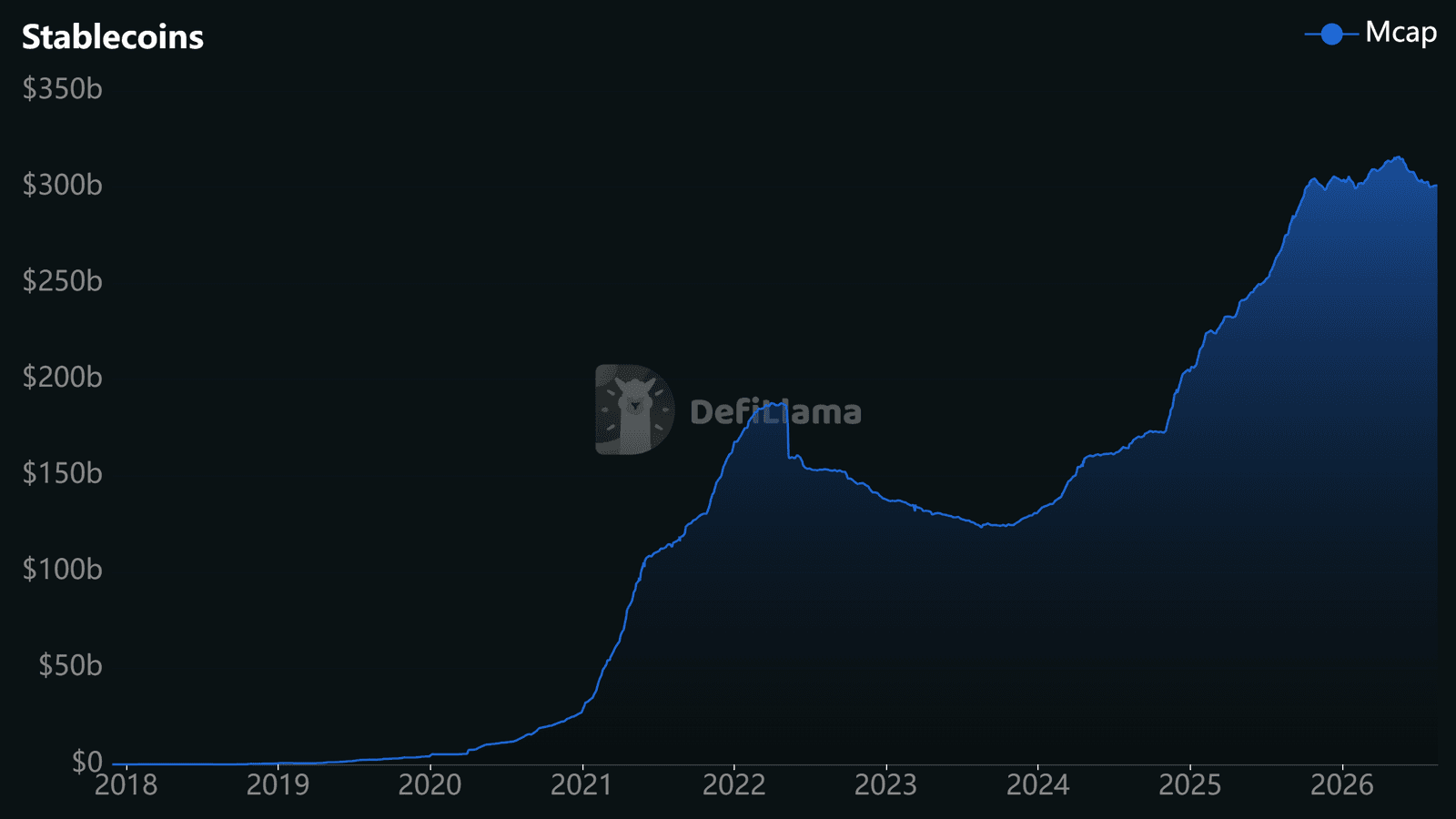
Use cases have also expanded. The world uses stablecoins to buy goods, grow savings, send remittances, settle cross-border business transactions, and access dollar-denominated financial services, all without relying entirely on traditional banking infrastructure. And of course, the assets remain deeply embedded across crypto’s more internal financial activity.
Past this point is where things start getting interesting for me.
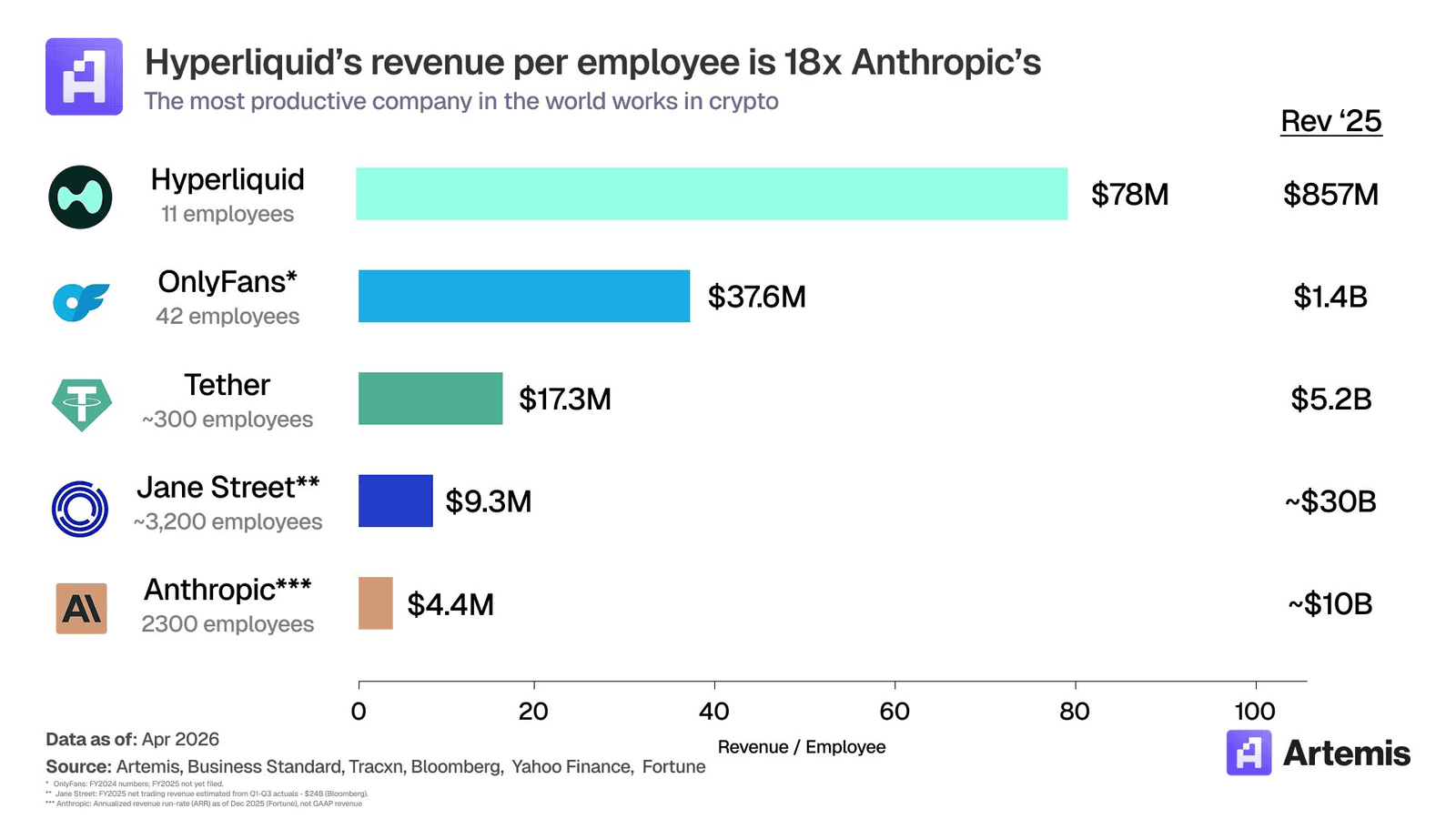
From all that stablecoin-reliant activity going on, the firms issuing the tokens have become major financial institutions. In the second quarter of 2026 alone, Tether (once famously the most profitable company in the world per employee, before Hyperliquid took the crown) reported $1.5 billion in Q2 net operating profit, while Circle generated $668 million of reserve income.
So, the question is: what are they doing with all that money?
Well, this is where you come with me to journey further down the iceberg.
How Stablecoin Issuers became Major Financial Players
Stablecoin issuers hold reserve assets that support the token’s value, commonly keeping it pegged to the dollar for easy use as currency.
Those reserves, which generate interest for the issuer, are largely composed of cash, short-term U.S. government debt, repurchase agreements, and other liquid instruments. Stablecoin adoption therefore has a compounding effect: greater demand creates more circulating tokens, which requires more reserve assets, which in turn can generate more income for the issuer.
To see just how large this business can become, take a look at Tether.
In 2025, Tether reported more than $10 billion of net profit, while its direct U.S. Treasury holdings exceeded $122 billion at year-end and its total direct and indirect Treasury exposure surpassed $141 billion when overnight reverse repurchase agreements were included.
At the end of the second quarter of 2026, approximately $184.6 billion of USDT had been issued. Tether reported total assets of $187.75 billion against $183.64 billion in liabilities, and reserves concentrated in short-duration, highly liquid assets, with the majority held in U.S. government-backed instruments and short-term liquidity facilities. The firm also reduced secured lending exposure by roughly $2.38 billion during the quarter while adding 14 tonnes of physical gold, bringing its holdings above 146 tonnes.
Those figures place Tether in two rare categories:
- One of the most profitable private FinTech companies
- One of the major global holders of government debt
It actually presents somewhat of a paradox when it comes to the relationship between stablecoin adoption and the traditional financial system. Stablecoins have often been described as an alternative to conventional banking rails, but their growth today creates substantial demand for TradFi assets. Every new dollar of USDT demand ultimately requires assets behind it, and a substantial portion of that backing has historically flowed into U.S. Treasuries and similar instruments.
This flywheel effect, where more stablecoin issuance = more U.S. Treasuries bought by the issuers, is why @goodalexander, among other sharp observers, has said that the U.S. Government’s encouragement of USD-based stablecoin adoption is imperative for the long-term continued dominance of the dollar.

And the economics apply to other stablecoin issuers as well.
At the end of Q2 2026, Circle, for example, reported $73.3 billion of USDC in circulation, up 19% from a year earlier. During the quarter, the company generated $668 million of reserve income, compared with $34 million of other revenue. Circle attributed the increase in reserve income largely to a 25% year-over-year increase in average USDC circulation, partially offset by lower reserve yields.
Even at a much smaller scale, and when the focus is not the dollar, as is the case with Schuman Financial and its EURØP euro-based stablecoin, a similar flywheel effect is in place.
The firm’s Q1, 2025 reserve audit reported 1,349,541 EURØP in circulation and 1,349,541 in cash reserves. Its Q2, 2026 reserve audit then detailed over 6.8 million EURØP in circulation, alongside an increased cash reserve to match:
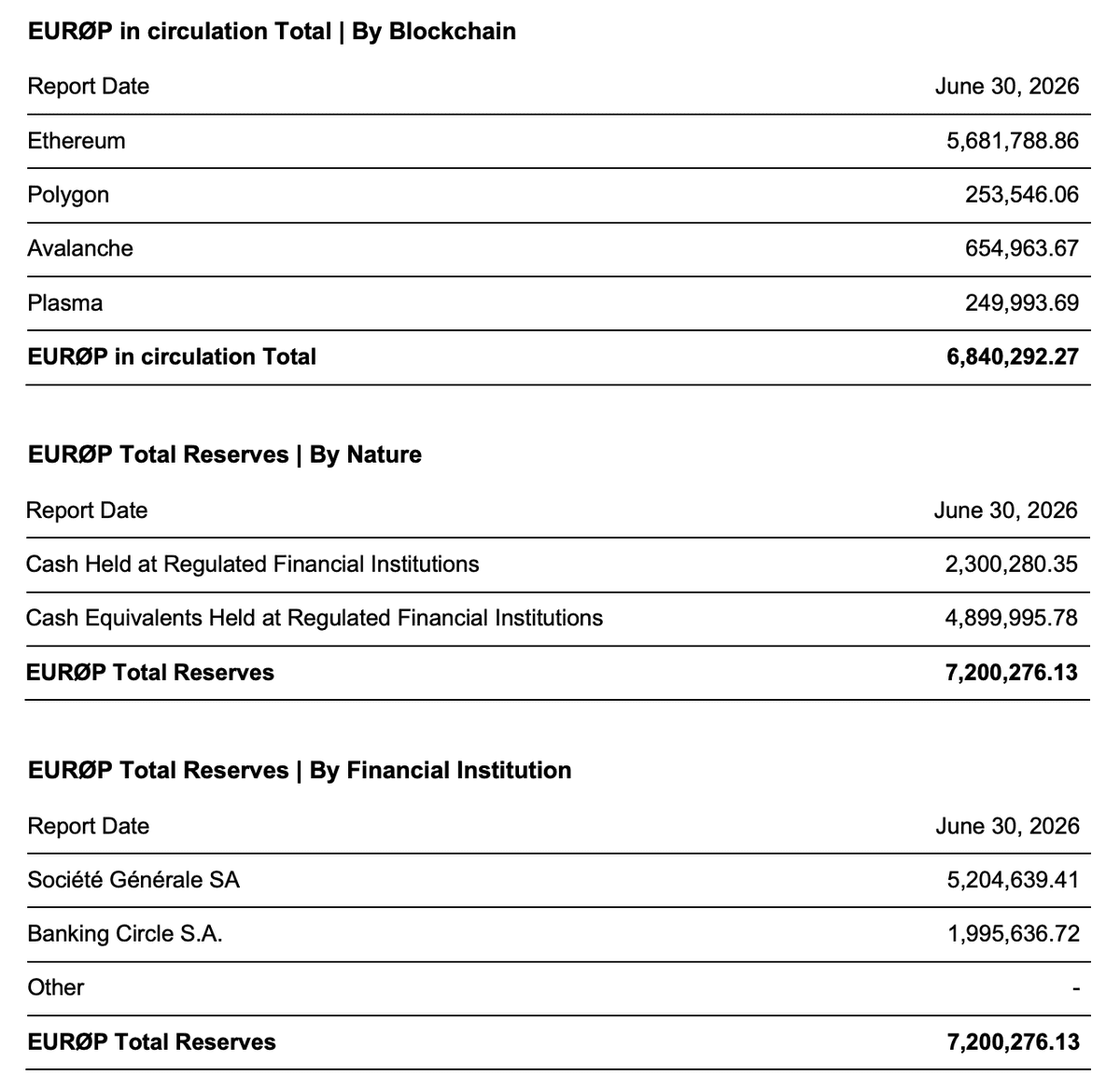
As we can see, an issuer that successfully distributes tens of billions of digital dollars can earn reserve income simply by maintaining the liquid assets necessary to support those tokens. That gives stablecoin issuers an economic model that combines elements of payments companies, asset managers, and financial institutions, but with distribution occurring through software and public blockchains.
To me, it’s one of the great marvels in modern finance.
And it gets even better 👇
Reserve Assets vs. Capital for New Bets
It’s important that we quickly pause to distinguish reserve assets from the capital that issuers are deploying into businesses as investments.
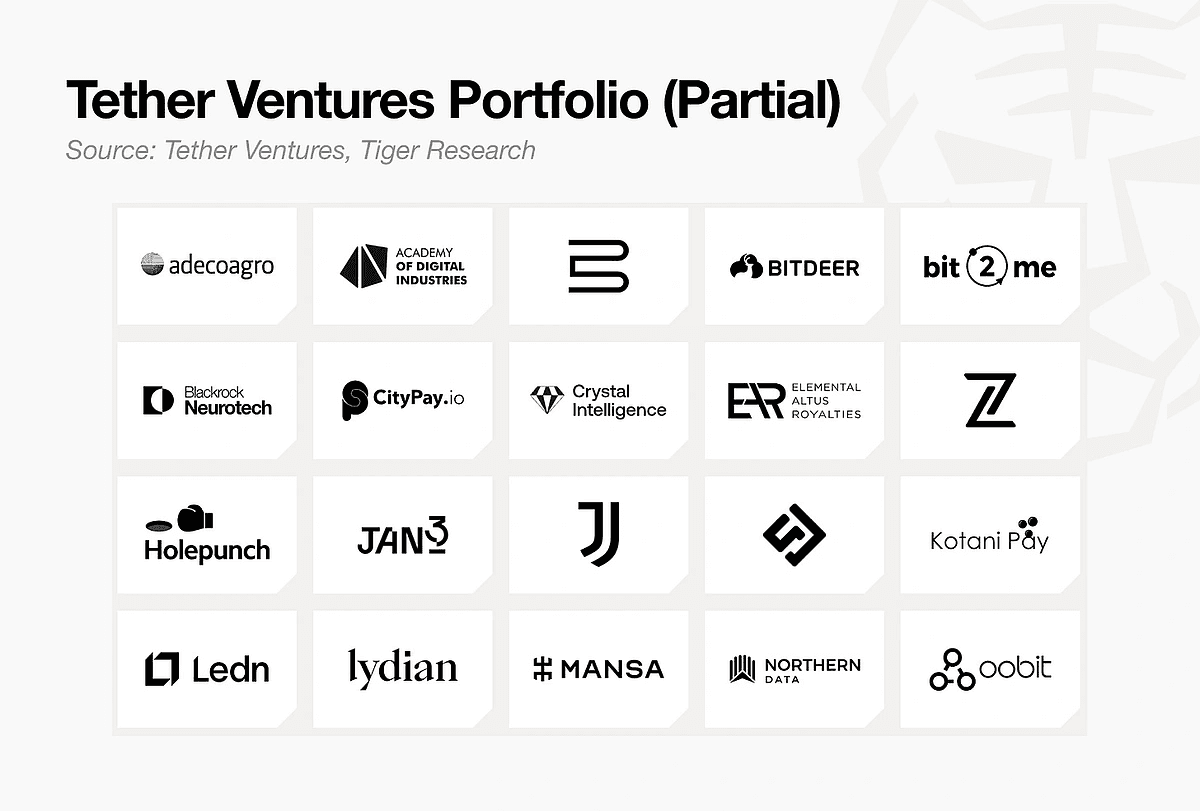
To be clear, the reserves backing USDT are not simply a fund that Tether can freely redirect into other investments. Tether has explicitly stated that its proprietary investments are funded from excess capital & profits and segregated from the reserves backing USDT. At the end of 2025, Tether said this proprietary investment portfolio exceeded $20 billion.
At this point, we return to our broader story, so let’s make sure we’re all aligned:
- Stablecoin adoption is not merely giving issuers larger balance sheets for earning interest. It’s also giving them substantial pools of corporate capital beyond the reserves required to support their tokens.
- Payments create distribution, distribution creates stablecoin demand, and that demand creates reserve assets. Those reserve assets generate income, and the resulting profits can then be reinvested into entirely new industries.
At this point, the stablecoin story moves beyond payments. Issuers have become major capital allocators in their own right, with the resources to build or invest in the infrastructure of anything they want.
What I’ve found is that they’re betting big on the machine economy.
Expanding the Empire into the Machine Economy
Tether has been actively investing profits into artificial intelligence (including its on-device QVAC platform and large GPU infrastructure via Northern Data), robotics (leading a major funding round of up to $1.4 billion in Neura Robotics and participating in Generative Bionics, with plans to integrate self-custodial wallets and edge AI so machines can hold and transact USDT), energy and Bitcoin mining, peer-to-peer communications infrastructure (Holepunch/Keet and a large stake in Rumble), tokenization platforms (Hadron for real-world assets and securities), and health technology (QVAC Health apps, Eight Sleep, and Blackrock Neurotech brain-computer interfaces).

Circle is expanding beyond stablecoins in a different direction. Instead of diversifying horizontally across industries like Tether, it is building up its vertical financial stack.
The firm now operates USYC, an onchain representation of a tokenized money-market fund backed primarily by reverse repos against U.S. government securities, giving eligible institutions access to yield-bearing collateral with 24/7 subscriptions and redemptions. It is also preparing to launch the public mainnet of Arc, its own Layer-1 blockchain designed as institutional-grade infrastructure for programmable finance, tokenized real-world assets, and capital markets.
To compliment this, Circle is also moving deeper into the TradFi system itself. In July 2026, it received final OCC approval to establish Circle National Trust, a federally regulated national trust bank that will provide institutional digital-asset custody and could eventually manage USDC reserves. Later that month, Circle acquired nearly 1,000 issued patents from IBM's blockchain portfolio, spanning banking, financial services, insurance, enterprise infrastructure, supply-chain verification, and secure cloud operations.
So we have two dominant stablecoin issuers with two different approaches, but one shared endgame that I see:
Tether and Circle are working to embed stablecoins directly into software agents and physical autonomous systems, enabling USDT and USDC to be held, spent, and settled by AI and machines. Pulling off the vision means clankers can exist as meaningful economic actors without human intervention, all while today’s stablecoin issuers grow far beyond payment solution providers. The market doesn’t see it yet, but the firms are morphing into a new class of full-stack technological powerhouses, aiming to acquire meaningful economic participation and influence over the future’s machine economy.
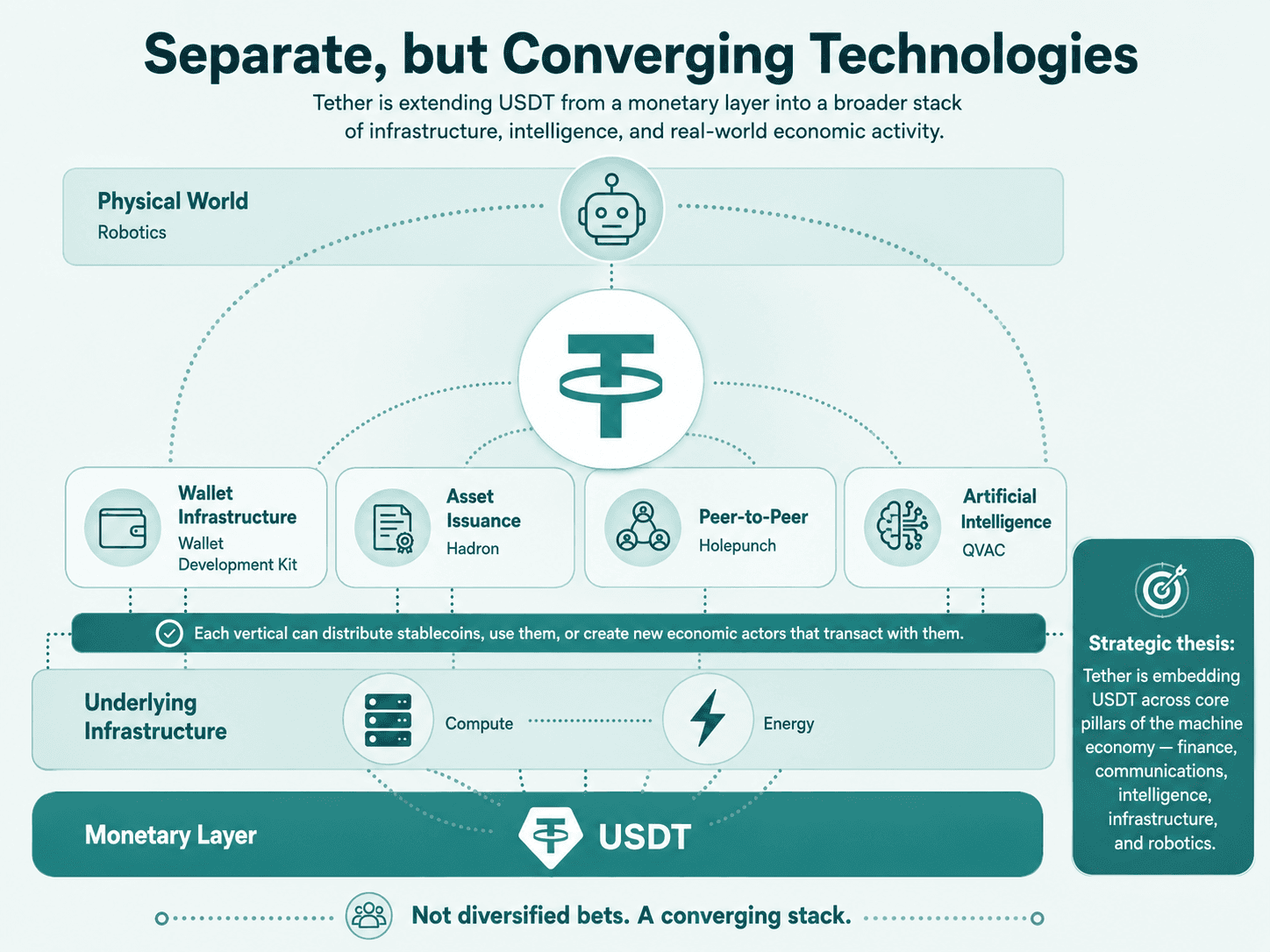
Separate, but Converging Technologies
It’s important that you look at Tether’s investments as aligned pieces to a larger strategic picture, not a group of diversified, isolated bets in the same way you see some VC firms operate.
Tether's investments are focused in AI, peer-to-peer communications, compute, energy, tokenization, financial infrastructure, health technology, and robotics. Each of these technologies can either distribute stablecoins, use them, or create new categories of economic actors capable of transacting with them. And however partitioned they are today, what’s clear to me (and presumably, Tether) is that they’ll become increasingly intertwined as we advance deeper into the machine economy era.
It’s a play to deeply engrain USDT into core pillar’s of our future society.
From Stable Money to Stable Intelligence
In April 2026, Tether launched the QVAC SDK, an open-source framework designed to let developers run AI locally across smartphones, laptops, servers, and other devices instead of depending exclusively on centralized cloud infrastructure.
QVAC supports text generation, embeddings, vision, speech, translation, and other AI workloads through a common interface, while incorporating peer-to-peer capabilities built on Tether-backed Holepunch infrastructure.
The philosophy behind QVAC closely resembles the argument Tether makes for stablecoins.
USDT gives users access to dollar-denominated financial infrastructure without requiring them to rely entirely on conventional banks. QVAC is intended to make advanced intelligence similarly accessible without requiring every interaction to travel through the centralized servers of a handful of Big Tech companies.
When launching the SDK, Tether CEO Paolo Ardoino described a future in which billions of people coexist with billions of autonomous machines and trillions of AI agents. His argument was that an AI architecture requiring every decision to pass through centralized servers would eventually become a constraint on that world.
That vision is what Ardoino calls a "Stable Society" built around both financial and intelligence inclusion. Tether has also said it plans to extend QVAC with tooling specifically designed for robotics and brain-computer interfaces.
In reviewing this, I think Tether's thesis is likely that the populations underserved by conventional financial infrastructure are increasingly facing a similar divide with access to frontier AI models. But if smartphones can locally run capable models without expensive subscriptions, reliable broadband connections, or continuous access to hyperscale data centers, AI can be democratized like how stablecoins are bringing dollars to the people outside the traditional system.
QVAC, in that regard, isn’t just some bet on a booming tech sector for Tether. It extends the same philosophy behind Tether's financial products into intelligence itself.
And this gets much bigger when we consider the growth of AI agents.
When AI Becomes a Meaningful Economic Actor
The vision for AI agents is truly autonomous actors that execute tasks on behalf of humans.
An AI agent tasked with completing an objective might need to tip a food delivery service, or pay a flower shop, but if those interactions ultimately require a human to enter card details or manually approve every transaction, the software is only partially autonomous; it can’t reach its end state.
Stablecoins, because they can be controlled programmatically, are the obvious solution here. I’m convinced they’ll end up as the go-to medium of exchange for agents (hell, maybe the agents will even create their own).
Circle agrees, and has made this opportunity an explicit part of its strategy.
In May 2026, the company launched Circle Agent Stack, a suite of tools designed to allow AI agents to hold assets, discover services, and transact using USDC within predefined permissions and spending limits.

Circle CEO Jeremy Allaire described the move:
“Financial infrastructure has historically been built for people, with manual onboarding, approvals, and payment flows that were never designed for software acting on its own. We believe the next phase of the global economy will be increasingly AI and agent-driven. The launch of Circle Agent Stack is exciting as it’s the first full suite of services we’re launching where AI agents themselves are the customers, not just developers and enterprises.”
The initial products of the Stack include Agent Wallets, an Agent Marketplace, developer tools, and Nanopayments, which are especially interesting to me because they focus on how the economics of agent transactions can look so different from human commerce.
An AI agent might make thousands of purchases worth fractions of a cent when paying separately for each query, second of compute, database lookup, or piece of information it consumes. Fixed card-processing fees or even conventional blockchain transaction fees quickly become impractical when the underlying payment itself is worth less than a penny.
Nanopayments solve this by enabling USDC transfers as small as $0.000001 by aggregating activity and settling it onchain in batches. Circle is positioning the system for pay-per-use APIs, compute billing, data access, and other high-frequency machine-to-machine transactions.
Robotics Brings the Machine Economy Into the Physical World
Today’s financial system, built for human commerce, was never designed around millions or billions of machines continuously initiating transactions with one another.
A truly autonomous robot may need to earn money for completing work, purchase electricity, rent compute, acquire data, pay software providers, compensate other machines, or manage an operating budget. As such, it cannot cannot depend on a human pulling out a credit card every time it requires a resource.
But stablecoins will give these machines the power to transmit value, which is why, to me, robotics is the most meaningful natural extension of the stablecoin thesis. That integration is essential for enabling the robotics industry—projected to reach roughly $5 trillion by 2050 with more than 1 billion humanoids in use worldwide—to reach maturity.
Tether has been dialed in here.
In June 2026, the firm announced that it would lead a financing round of up to $1.4 billion for NEURA Robotics, a German Physical AI company developing humanoids, robotic arms, autonomous mobile robots, and service robots. The financing made Tether a significant capital provider to the emerging humanoid sector, and the planned technological integration is more consequential for the stablecoin story.
Tether plans to deploy both its AI and financial infrastructure directly into NEURA's robotics ecosystem.

NEURA's machines are expected to integrate Tether's Wallet Development Kit, embedding self-custodial wallet functionality into the robots themselves. Tether says this could allow machines to receive micropayments for completed tasks, transact with other systems, or execute financial actions on behalf of humans within predefined parameters.
At the same time, NEURA plans to test and deploy QVAC as an edge AI runtime, allowing intelligence to execute locally on the machines rather than requiring every decision to be processed remotely in the cloud. QVAC gives the machine a potential intelligence layer. WDK gives it a financial layer.
A sufficiently autonomous robot could therefore do more than perform a task. It could perform work, receive payment for that work, pay for resources it requires, interact financially with other systems, and continue operating according to rules established by its owner.
Tether has outlined where it believes this all leads:
“For Tether, this is a decisive move towards the next industrial frontier. After building the monetary rails that move hundreds of billions of dollars across borders, Tether is now backing the machines that will act, react, and transact in the physical world. This investment continues to push the company beyond digital liquidity and into the space where robotics, edge AI, and embedded financial systems converge. With this investment, Tether continues to position itself inside the core technology stack of the machine economy, backing systems that combine autonomy, on-device AI, and native economic functionality. The focus is no longer only on enabling markets; it is on enabling machines to participate in them.”
The NEURA deal is also not Tether's first move into robotics. In December 2025, Tether participated in a €70 million financing round for Generative Bionics, an Italian humanoid robotics company preparing systems for manufacturing, logistics, healthcare, retail, and other environments. The investment was specifically intended to support Physical AI and edge-AI development alongside the company's humanoid platform.
Completing the Money Infrastructure Stack
Essential to delivering on the AI & robotics x stablecoin vision are the supporting infrastructure pieces that are placed around the core stack. Tether’s expansion via investment, as such, is considerably broader than just those two sectors.
The company’s portfolio also covers financial services, energy, biotechnology, education, digital media, commodities, remittances, and other industries.
Let’s dive into a few examples worth exploring in greater detail.
Local AI may reduce dependence on centralized data centers for some workloads, but developing and training advanced models still requires enormous computing resources.
That’s why we see Tesla, for example, spending aggressively to secure its own AI compute base. The company has been building Cortex, a large AI training cluster at Gigafactory Texas, to accelerate Full Self-Driving and robotics development.

In 2025, Tether signed an agreement to lease a significant share of a 20,000-plus GPU network connected to the Rumble and Northern Data ecosystem to support QVAC, AI research, and other applications. This scale gives Tether access to the kind of compute base associated with the handful of companies trying to train and deploy global-scale models.
It doesn’t matter how fast your car is; without gas, you go nowhere.
All the same, that’s why energy is the most important piece of the machine economy stack. It’s the primary constraint everywhere you look across emerging tech, whether it’s data centers, large-scale robotics, or AI inference. And as these technologies have scaled over the past few years, their demand for power has already become enormous.
The International Energy Agency projects that global electricity consumption from data centers will more than double by 2030 to roughly 945 terawatt-hours, which is slightly more than Japan consumes today. AI is expected to be the biggest driver of that increase, with electricity demand from AI-optimized data centers projected to more than quadruple over the same period. In the U.S., data centers are on pace to account for almost half of all electricity-demand growth between now and 2030.
Markets have already been pricing this in. Probably most famously, Leopold Aschenbrenner, the former OpenAI researcher behind the hedge fund Situational Awareness, essentially turned his superintelligence thesis into a massive AI-infrastructure trade. The bet was that the race to scale AI would create huge winners across the physical stack required to support it: semiconductors, compute providers, memory and storage, power companies, and Bitcoin miners or data-center-adjacent energy assets. That trade scaled Situational Awareness from roughly $225 million in assets at launch to a peak of around $45 billion.
And it’s not just tech-driven demand that’s reducing available energy.
More recently, markets have been responding to the broader energy crunch impacted by the Iran War. The conflict has created an extraordinary earnings season for U.S. refiners, with global refined-fuel shortages pushing refining margins sharply higher, even after Brent crude fell from its wartime peak. Marathon Petroleum, Valero, and Phillips 66 were all major beneficiaries, with shares up 110%, 98%, and 75%, respectively, outpacing the broader energy sector.
Like Aschenbrenner’s trade, the theme here is that when energy becomes scarce, the companies that control an element of its production, processing, or reliable delivery, can suddenly become far more powerful and strategically valuable. Over the longer term, I see the AI and machine-economy buildout creating a similar premium around power generation, grid access, on-site energy, and infrastructure that can keep compute and autonomous systems running.
And that’s where it’s relevant to stablecoin issuers. Without a strategy in place to exercise control over the energy needed to fuel their machine economy endgame vision, they’d be at the mercy of the companies that hold that control. Therefore, becoming a meaningful investor and builder in energy is a play with huge implications; it’d give the issuer a direct path to accessing the power capacity its own ecosystem will eventually demand.
And that’s exactly what Tether has done.
- In 2025, Tether acquired a 70% controlling stake in Adecoagro, a South American sustainable production company with operations across agriculture and renewable energy. The deal gives Tether exposure to three things that matter for the broader machine-economy thesis: real-world commodity flows, renewable power, and infrastructure in emerging markets where stablecoin adoption already has a natural use case.
- Tether participated in the first round of Volcano Energy, a $1 billion renewable-energy initiative in Metapán, El Salvador. The project was designed as a 241 MW generation park combining 169 MW of solar and 72 MW of wind power, with the output expected to support one of the world’s largest Bitcoin mining farms.
- Tether also launched renewable-powered Bitcoin mining operations in Uruguay, a country it highlighted for its unusually high share of renewable electricity. The venture ended in August due to a dispute with the state power company, but it will surely be valuable experience for the team moving forward.
- Through Adecoagro, Tether is also exploring renewable-powered Bitcoin mining in Brazil, using electricity produced from Adecoagro’s agricultural operations. The idea is to turn renewable energy that might otherwise be sold into volatile spot markets into a more programmable economic input: power can be monetized through mining, mining produces Bitcoin exposure, and the whole loop connects agricultural energy production with digital infrastructure.
In March 2026, Tether invested in Eight Sleep at a $1.5 billion valuation, with the companies planning to use QVAC to develop local AI features around sleep and personal health data. Tether has separately launched QVAC Health, which is designed to process health and wellness data locally rather than requiring users to surrender that information to centralized cloud platforms.
Tether's AI roadmap also explicitly identifies brain-computer interfaces as a future QVAC application, another area in which the company has already invested. Its portfolio includes Blackrock Neurotech, a developer of brain-computer interfaces intended to help people interact with devices through neural signals.
Tech Giants in the Making
The stablecoin boom is producing a different kind of category leader. Ford dominated the early automobile industry by making cars… and kept making cars. Apple rose to dominate the computer revolution, and pressed its advantage by creating new forms of computers.
But here we have Tether and Circle, which began with digital money, pushing for expansion into entirely separate industries, driven by ambitions far beyond the product that first made them powerful.
That is what makes this moment so compelling. The growth of stablecoins is not only enlarging issuers’ balance sheets; it is giving them the capital and strategic position to help shape the machine economy their currencies will eventually serve.
It’s quite the experiment we’re watching unfold: financial infrastructure companies attempting to become broad technological powers while the next economy is still being built.
If that experiment succeeds, the leading stablecoin issuers will sit between two economies. In the human economy, their currencies will continue moving between workers, savers, consumers, traders, and businesses around the world. Alongside it, the machine economy emerges, in which software and physical machines become financial actors themselves. Instead of merely supplying the money for that world, the issuers are building the world around it.
I think it changes how the firms’ legacy will ultimately be understood.
Transforming global payments could prove to be only the first act. The larger achievement would be turning that monetary foothold into an enduring position that defines what actors can participate in the machine economy, and in what ways.